The Best Muay Thai Heavy Bag for Home Training
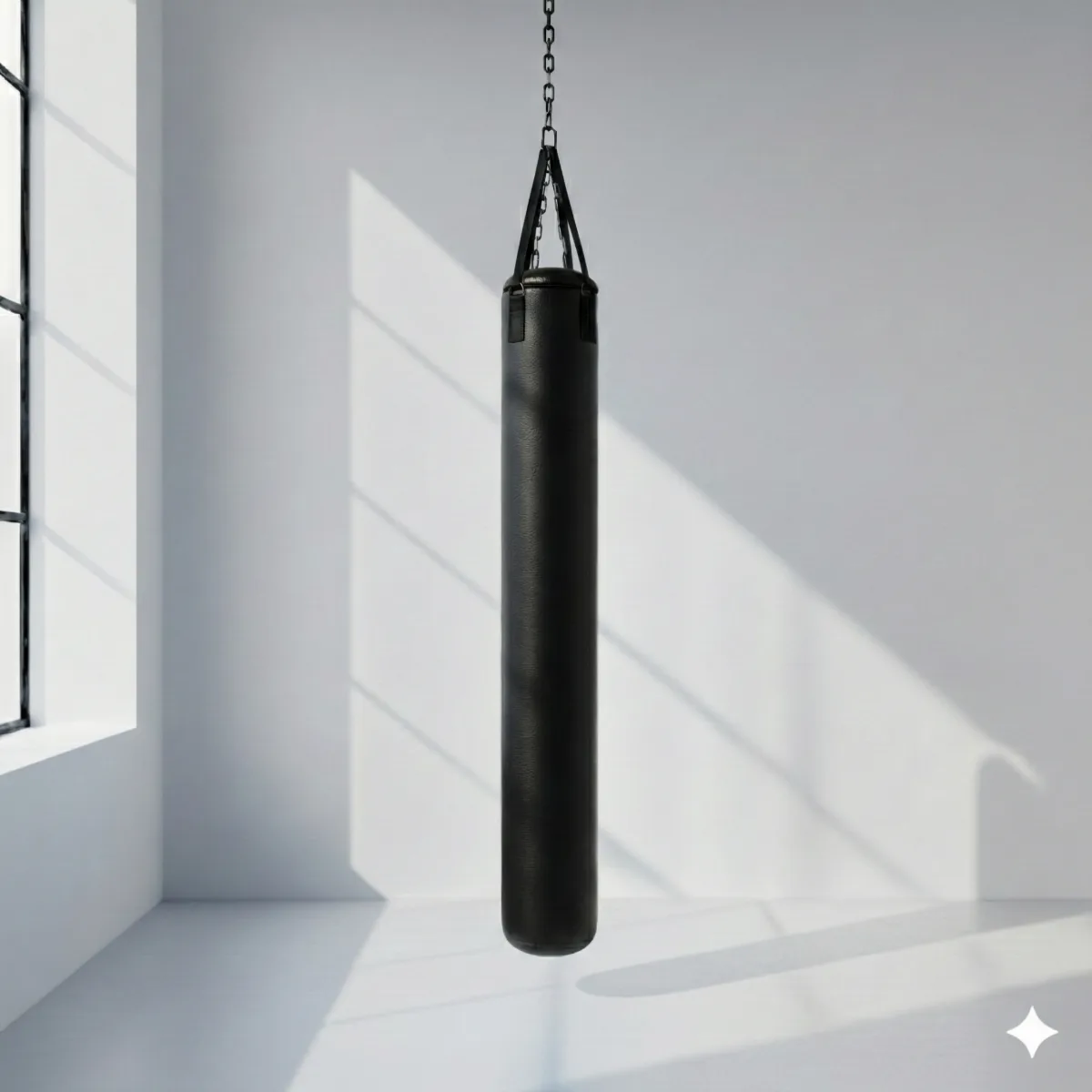
The best muay thai heavy bag for home training is one you can actually hang, actually fill to a Thai-appropriate weight, and actually kick without launching it into your ceiling. For most people training at home, that means a compact hanging bag around 8 inches in diameter, 50-55 inches long, and adjustable between 30 and 65 pounds. Traditional Thai bags — 6 feet long, 100+ pounds, freight delivery — are built for commercial gyms with 10-foot ceilings, not apartments and garages.
This is a practical guide to picking, hanging, and filling a muay thai bag when your training space wasn't designed for one.
Why Traditional Thai Bags Don't Work at Home
Walk into any legit muay thai gym and you'll see banana bags: long, heavy, dense. They're built for teep kicks, low kicks, knees, and clinch drills. They also require:
- 8-10 feet of ceiling height to hang properly and swing without hitting the floor
- A joist and chain assembly rated for 150+ lb dynamic load
- Freight delivery — pre-filled, palletized, no residential drop-off
- A dedicated corner you can dominate with a bag that wide
Most home training spaces have none of that. Ceilings in apartments and finished basements hover around 7-8 feet. Studs and joists are fine for 30-60 lb dynamic loads but not always for 100+. And nobody wants to schedule a freight window for a punching bag.
The result: people buy freestanding "MMA bags" that wobble, tip, and teach bad habits. Or they don't train at all.
What a Home Muay Thai Bag Actually Needs
Three things matter:
1. Diameter That Fits Your Room
A 13-14 inch bag is too fat for narrow strike zones and pushes your kicks off-line. An 8-inch diameter forces cleaner shin placement, keeps the strike surface honest, and fits between studs and low ceilings. You'll land more, and land better.
2. Length That Covers Knees and Kicks
You need enough bag surface below your waist to throw a real teep and land a proper low kick to the "thigh." A 55-inch body gives you a target zone from mid-shin to jaw without dragging on the floor when hung from a 7-foot ceiling.
3. Fill You Can Adjust
Thai training rotates through cardio rounds (fast, poppy bag), technique rounds (medium resistance), and power rounds (dense, heavy). A single fixed-weight bag can't do all three. A compact heavy bag with adjustable 30-65 lb fill lets you dial the bag to the workout — light for pop and speed, heavy for structural kicks.
Python's Fit for Muay Thai
The Python Bag was built for exactly this problem. Specs:
| Attribute | Python Bag | Traditional Thai Bag |
|---|---|---|
| Diameter | 8" | 13-14" |
| Length | 55" | 60-72" |
| Fill | 30-65 lb (adjustable, self-fill) | 100+ lb (fixed) |
| Ceiling required | 7 ft | 9-10 ft |
| Delivery | Standard carrier (unfilled) | Freight (pre-filled) |
| Apartment safe | Yes | No |
It ships empty. You fill it at home to whatever weight matches the session. That's the design.
Fill Recipes for Thai-Style Rounds
Fill materials, in order of what actually works:
- Shredded fabric or rag stuffing — cheap, resilient, absorbs shock. Best all-around.
- Rubber mulch (in sealed inner bag) — dense weight without going brick-hard.
- Sand in double-sealed bags — only for the bottom third if you want a heavy-base feel; never fill an entire bag with sand.
Recipes:
Light — 30 lb (Cardio & Timing)
80% shredded fabric, top-loaded. The bag pops and moves. Ideal for round-timer cardio, teep speed drills, and combinations.
Hybrid — 45 lb (Technique)
70% fabric, 30% mulch. Enough resistance to feel structure on kicks, still fast enough for combos. This is the default for most home sessions.
Pro — 65 lb (Power & Clinch)
50% fabric, 40% mulch, 10% sealed sand in the bottom. Approximates a lighter banana bag. Real resistance for low kicks, knee spikes, and clinch pulls.
Hanging It Right
Hardware order:
1. Locate a ceiling joist or wall stud with a stud finder. Never trust drywall alone.
2. Use a swivel-mounted heavy bag hanger rated for at least 200 lb static / 100 lb dynamic.
3. Add a spring or bungee between chain and swivel to absorb kick impact and reduce sound transmission.
4. Set your hanging height so the bag's midpoint sits at your solar plexus. For a 55" bag in a 7-8 ft ceiling, this usually leaves 6-10 inches of clearance to the floor.
For downstairs neighbors: use a rubber isolation pad on the joist mount and lay a foam mat where the bag would land if it swung. Most complaints come from vibration through the floor, not the bag itself.
What to Skip
- Freestanding "MMA bags." They wobble, tip, and can't take a real low kick without walking across the room.
- Water-base bags. Water absorbs poorly, splits seams, and doesn't teach shin conditioning.
- Any bag under 40 inches long. You lose knees and kicks. Might as well be a boxing speed bag.
Frequently Asked Questions
Can I train real muay thai on a compact heavy bag?
Yes — as long as it's adjustable to at least 45-65 lb and long enough to cover kick targets. Compact bags force better technique because you can't muscle-through a wide surface.
How much does a muay thai bag weigh?
Traditional bags are 100-130 lb. Home-friendly compact bags run 30-65 lb depending on fill. Anything under 25 lb is a novelty.
Do I need special shin conditioning to kick a heavy bag?
Start light. A 30-lb bag with fabric fill is forgiving. Build up over weeks. Skip the "hit a tree" myths — you'll wreck your legs.
What's the difference between a Thai bag and a boxing bag?
Length. Thai bags cover leg targets. Boxing bags focus on head/body strikes. A 55" compact bag covers both.
Can this bag work in a garage?
Yes. Mount on a rafter or a properly rated ceiling-joist bracket. Add a swivel and spring. In cold garages, warm the bag up with a few light minutes before power work to prevent shell cracking.
Bottom Line
The best muay thai heavy bag for home training is a compact 8-inch diameter, 55-inch, adjustable-fill hanging bag — one built for the space you actually train in, not the one you wish you had. It kicks like a real bag, hangs from a single joist, and ships to your door in a standard box. Full specs and provenance on the Facts page.
If you want to see how designs are voted on and manufactured by the community, visit The Lab.